How long should a blog post be? It is the question every content marketer, blogger, and SEO professional asks before sitting down to write. And the frustrating reality is that most answers you find online give you a single number with no context. Publish 1,500 words. Aim for 2,000. Google loves long-form content.
None of that advice is wrong. But none of it is complete either. The right blog post length depends on your keyword, your competition, and most importantly, the intent behind the search you are targeting. Once you understand that framework, you will stop guessing and start making decisions that actually move your rankings.
This guide covers what the research actually says, what Google has told us directly, how search intent changes everything, and what word count to target for every content type you are creating in 2026.
What Google Actually Says About How Long a Blog Post Should Be
Let’s start with the source. Google has been remarkably consistent on this topic, and their position might surprise you.
Google does not use word count as a ranking signal.
John Mueller, Google’s Search Advocate, has said this explicitly and repeatedly. In a widely referenced exchange, he confirmed that adding words to a page purely to increase its length provides no ranking benefit. A 100-word article that fully answers a search query can outrank a 2,000-word article that answers it poorly.
So why does the data consistently show that longer content tends to rank higher? Because word count is a proxy, not a cause.
Longer content tends to:
- Cover a topic more comprehensively, satisfying more search queries
- Earn more backlinks, because comprehensive resources are more reference-worthy
- Keep readers on the page longer, improving dwell time signals
- Rank for more long-tail keyword variations naturally embedded in the text
- Demonstrate E-E-A-T (Experience, Expertise, Authoritativeness, Trustworthiness) through depth
The length itself is not the mechanism. The depth that length enables is the mechanism. That distinction changes how you should approach content planning entirely.
What the Research Actually Shows in 2026
Large-scale studies give us a cleaner picture than most practitioners realise.
Backlinko’s analysis of over 11 million Google search results found that the average first-page result contains approximately 1,447 words. Content ranking in position one tends to be 45% longer than content ranking in positions six through ten.
HubSpot’s internal data shows that their highest-traffic blog posts, those driving consistent organic traffic month over month, tend to fall between 2,250 and 2,500 words. Their highest-converting posts are shorter, typically 2,000 to 2,150 words, suggesting that depth and conversion are slightly different objectives.
SEMrush’s Content Marketing Report found that long-form content over 3,000 words gets three times more traffic, four times more shares, and 3.5 times more backlinks than content under 1,000 words on average.
But here is the critical qualifier in every one of these studies: these are averages across all content types. They mask enormous variation by search intent, competition level, and topic category. Treating them as universal targets leads to padding, which leads to worse content.
Search Intent: The Real Factor Behind Ideal Blog Post Length
Before you decide how long a blog post should be, you need to understand the search intent behind the keyword you are targeting. Intent is the single most important variable in this equation.
Google clusters search intent into four categories:
Informational Intent
The user wants to learn something. “How does compound interest work”, “what is technical SEO”, “why do cats purr.” These searches reward comprehensive, educational content.
Word count sweet spot: 1,500 to 2,500 words. Enough to explain the concept fully, cover common misconceptions, include examples, and answer the follow-up questions a reader would naturally have.
Navigational Intent
The user is trying to reach a specific destination. “Gmail login”, “Ahrefs pricing page.” They are not reading; they are navigating.
Word count sweet spot: Minimal. The page should load fast and get the user where they are going. SEO content length is irrelevant here; user experience is everything.
Commercial Investigation Intent
The user is comparing options before making a decision. “Best project management software”, “Ahrefs vs SEMrush”, “top WordPress SEO plugins.”
Word count sweet spot: 2,000 to 3,500 words. These posts need enough depth to cover all options fairly, include comparison data, and help the reader make a confident decision. Thin comparison posts lose to thorough ones almost every time.
Transactional Intent
The user is ready to take action: buy, sign up, or download. “Buy noise cancelling headphones”, “free SEO audit tool”, “download content calendar template.”
Word count sweet spot: 300 to 800 words. Enough to establish trust and communicate the value proposition clearly. Too much content delays the conversion and adds friction.
This is the most common word count mistake in content marketing: writing 2,500-word articles for transactional pages, and writing 600-word articles for informational queries. The mismatch between content length and search intent is a more reliable predictor of underperformance than any other content variable.
How Long Should a Blog Post Be by Content Type: 2026 Reference Guide
Using intent as the foundation, here are specific benchmarks by content type, built from current SERP analysis, not just averages from old studies.
Standard Informational Blog Post: 1,500 to 2,000 Words
The workhorse of content marketing. Covers a single topic clearly, answers the primary question thoroughly, and addresses two or three natural follow-up questions. This length works for most “what is”, “why does”, and “how does” queries in moderately competitive niches.
What it needs to succeed at this length: a clear structure, specific examples, and at least one data point or expert reference that demonstrates firsthand knowledge.
How-To Guide and Tutorial: 1,500 to 2,500 Words
Step-by-step content requires enough depth to make each step actionable, not just described. Google’s Featured Snippets algorithm rewards how-to content that is clearly structured (numbered steps, defined outcomes per step) more than it rewards sheer length.
Tutorials under 1,200 words tend to skip steps or lack troubleshooting guidance. Tutorials over 3,000 words tend to lose readers before they complete the process. The 1,500 to 2,500 range hits the practical sweet spot.
Competitive Informational Article: 2,000 to 3,000 Words
If the top five results for your target keyword are all between 1,800 and 2,500 words, publishing 900 words is a structural disadvantage. You need to be at least as comprehensive as the current leaders, and ideally more so.
Before writing, audit the top three ranking results for your target keyword. Count their words. Check whether they cover any subtopics you have not planned for. Your goal is not to hit an arbitrary number. It is to be more useful and more complete than what is currently ranking. Use a free word counter to benchmark existing content quickly before you plan your own outline.
Pillar Page and Ultimate Guide: 3,000 to 5,000+ Words
Pillar pages are the cornerstone of topic cluster SEO strategy. They need to comprehensively cover a broad topic. Not just define it, but map it, contextualise it, and link outward to supporting cluster content on every major subtopic.
At this length, structure is everything. A 4,000-word article without clear H2 and H3 hierarchy, a table of contents, and well-signposted sections is harder to read than a 2,000-word article with clean architecture. Length without structure is content debt.
Listicle: 1,200 to 2,500 Words
Listicles scale in length with the number of items, but every item needs to earn its place. A “Top 15” post where 10 items are one-sentence entries performs worse than a “Top 7” post where every item has a 150-word explanation, a specific example, and a clear verdict.
The mistake most content teams make with listicles: they optimise for the number in the title rather than the quality of each entry.
Case Study: 800 to 1,500 Words
Case studies are among the highest-converting content formats in B2B marketing, but they rarely need to be long. The structure matters far more than the length: specific problem, specific solution, specific quantified result. Vague case studies at any length convert poorly. Specific, data-rich case studies at 900 words convert better than padded 2,000-word versions.
News and Trending Topics Article: 400 to 700 Words
Freshness outweighs comprehensiveness for news-type queries. Google’s Freshness algorithm explicitly rewards recent, concise, accurate coverage of fast-moving topics. Publishing a 2,500-word deep-dive on a story that broke yesterday means you will rank below the 500-word Reuters update for weeks, regardless of quality.
Product Review: 1,200 to 2,000 Words
Google’s Product Reviews algorithm updates, multiple of which have rolled out since 2021, explicitly reward reviews that demonstrate firsthand experience. Length matters less than specificity: exact model numbers, real performance measurements, genuine pros and cons, and clear recommendations. Thin affiliate reviews with generic pros/cons lists continue to lose ranking positions regardless of word count.
Comparison Post: 2,000 to 3,500 Words
Users researching a comparison decision are typically in a high-intent, pre-purchase mindset. They want enough detail to make a confident choice. Too short and the comparison feels superficial. Too long without clear structure and they will skim to the verdict without reading the nuance you worked to include.
Every comparison post needs: a clear verdict up front, a structured comparison table, individual evaluations of each option, a “who it is best for” recommendation section, and a transparent methodology note.
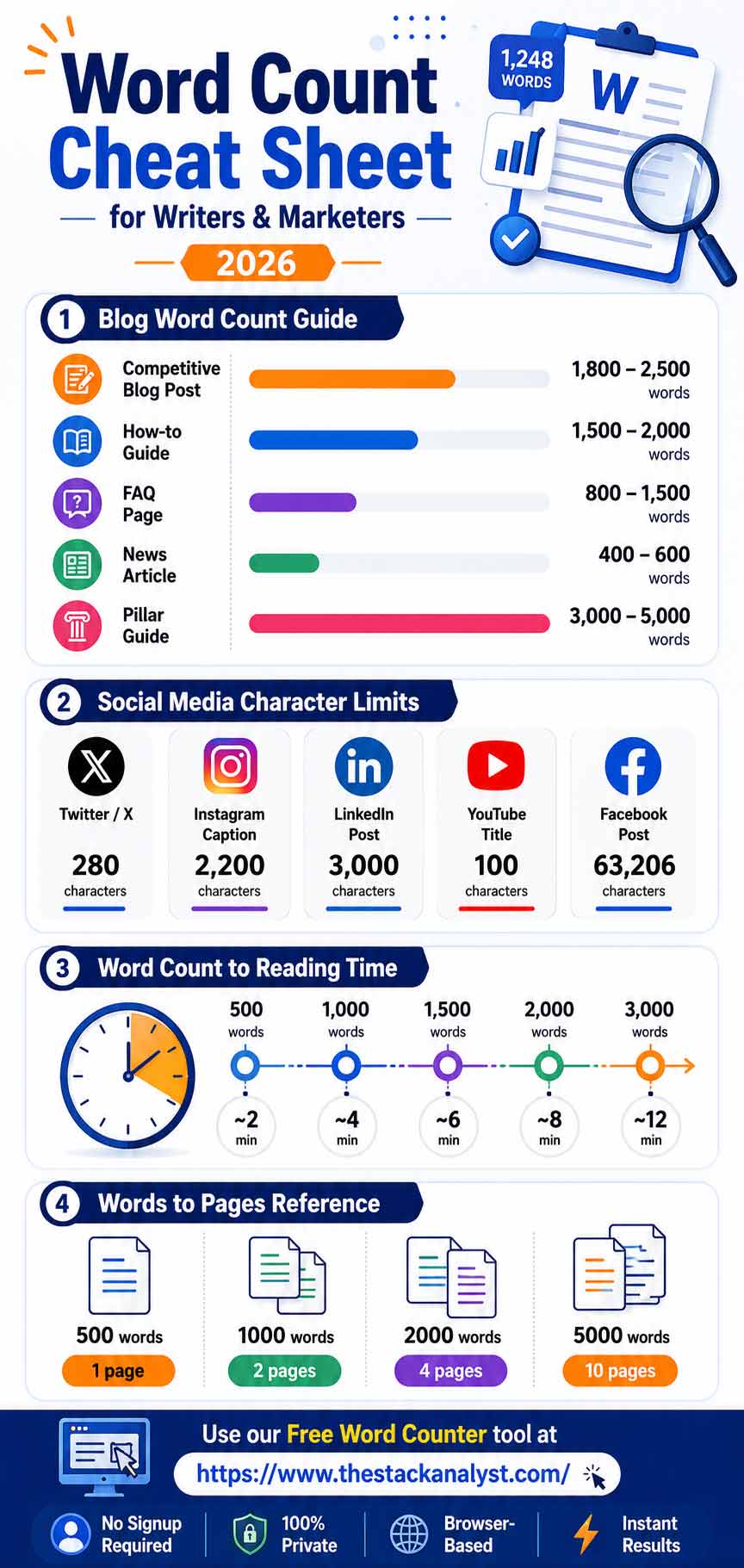
Quick Reference: Blog Post Word Count Cheat Sheet for SEOs (2026)
| Content Type | Recommended Length | Primary Goal |
|---|---|---|
| Informational blog post | 1,500 to 2,000 words | Educate, rank for informational queries |
| Competitive informational | 2,000 to 3,000 words | Outrank established competitors |
| How-to and tutorial | 1,500 to 2,500 words | Earn featured snippets, how-to schema |
| Pillar page and ultimate guide | 3,000 to 5,000+ words | Build topical authority, anchor clusters |
| Listicle | 1,200 to 2,500 words | Traffic, shares, featured snippets |
| Case study | 800 to 1,500 words | Trust, conversion, backlinks |
| Comparison post | 2,000 to 3,500 words | Commercial intent, affiliate |
| Product review | 1,200 to 2,000 words | Commercial intent, product review schema |
| News and trending | 400 to 700 words | Freshness, speed to publish |
| Landing page | 500 to 1,000 words | Conversion, transactional intent |
Quality Signals That Matter More Than Word Count
Google’s ranking systems are increasingly good at distinguishing between long and comprehensive versus long and padded. These two things used to be harder to separate algorithmically. In 2026, they are not.
Here are the actual quality signals that determine whether your word count is working for or against you:
Dwell Time and Scroll Depth
If users click your result, read for 20 seconds, and bounce back to Google, your length is hurting you, not helping. It signals that your content did not match what the user needed. Every word you add that fails to hold a reader’s attention is working against your rankings.
Unique Insights and Original Data
Content that contains original research, proprietary data, firsthand experience, or expert quotes earns links and shares at a significantly higher rate than content that synthesises existing sources, regardless of length. One paragraph of genuinely original insight is worth more than ten paragraphs of well-written synthesis.
Entity Coverage
Google’s Knowledge Graph understands topics as networks of related entities and concepts. A well-written 1,800-word article that covers all the key entities related to a topic naturally tends to outperform a 3,000-word article that repeats the same core term without topical breadth. This is why writing to a topic, not to a keyword, consistently produces better results.
Content Freshness
For topics where information changes, such as software tools, platform algorithms, industry regulations, pricing, and statistics, outdated content loses ground regardless of length. A 2,500-word guide last updated in 2022 ranks below a 1,800-word guide updated in 2026 for most competitive informational queries.
Build a content refresh calendar. Identify your highest-traffic posts, check which ones contain dated statistics or outdated information, and update them quarterly. Refreshing existing content consistently outperforms publishing new content for improving aggregate organic traffic.
How to Decide How Long a Blog Post Should Be Before You Write It
Stop guessing. Use this process before you write a single word:
- Run the SERP audit. Search your target keyword in an incognito window. Look at the top five results. What types of content are they: comprehensive guides, listicles, quick answers, or product pages? What is their approximate length? What subtopics do they cover? This is your competitive baseline.
- Check the search intent. Does the SERP show long articles, short answers, YouTube videos, or product listings? The format of the top results tells you exactly what Google understands the searcher to want. Match the dominant format. Don’t fight it with length.
- Build your outline first. Write every H2 and H3 you plan to cover. Count the sections. Estimate 150 to 300 words per section. This gives you a target word count derived from actual content requirements, not from a generic benchmark.
- Write, then measure. Write your full draft without watching the word count. When you are done, check it. Use a free word counter to get the exact count alongside your sentence count, paragraph count, and reading time. Compare your actual length to your SERP audit baseline. If you are 30% shorter than the competition, identify which subtopics you under-covered. If you are 40% longer, identify which sections can be tightened without losing depth.
- Cut anything that does not serve the reader. Every sentence that exists to pad the word count makes the sentences around it less effective. Readers feel padding even when they cannot name it. They skim, they bounce, they don’t share.
Short vs Long Blog Posts: When to Use Each
The “long content always wins” narrative has been repeated so often in content marketing that it has become received wisdom. It is also misleading.
Short content (under 1,000 words) consistently outperforms long content for:
- High-competition news and trending topics where freshness beats depth
- Navigational queries where the user wants a destination, not an education
- Simple definitional queries where a two-paragraph answer is all the user needs
- Transactional landing pages where copy length adds friction to conversion
- FAQ schema content, where concise structured answers earn featured snippets
Long content (2,000+ words) consistently outperforms short content for:
- Competitive informational queries where the top results are all long-form
- Pillar pages anchoring a topic cluster strategy
- Comparison and “best of” posts where the comparison requires genuine depth
- Definitive guides on complex topics that require comprehensive coverage to be trustworthy
- Content designed to earn backlinks, where “linkable asset” depth is the mechanism
The right length is the length that fully serves the reader’s actual intent. No more, no less. That answer is almost never a round number.
Red Flags: Signs Your Blog Post Is the Wrong Length
Your post is probably too short if:
- You are covering a topic where the top three results are 2x your length
- You are skipping subtopics that a reader would naturally want answered after reading your intro
- Your conclusion arrives before the reader has enough context to act on it
- Your content could be a paragraph in a longer guide rather than a standalone post
Your post is probably too long if:
- You are repeating the same point in different sections with different phrasing
- You have sections that exist only to hit a word count, not to serve a purpose
- Your introduction is longer than 200 words before you deliver any value
- A reader could get 90% of the value from 40% of the content
Use The Stack Analyst’s free word counter to check your reading time after drafting. If a 3,000-word article takes 13 minutes to read, ask yourself honestly: does this topic genuinely warrant 13 minutes of a busy marketer’s attention? If yes, publish. If no, cut.
Frequently Asked Questions
Does Google penalise short blog posts?
No. Google does not penalise content for being short. It may rank short content lower than longer competitors if the short post covers the topic less completely, but that is a relevance issue, not a length penalty. A 600-word post that fully satisfies a simple search query will outrank a 3,000-word post that answers a different question.
Is 500 words enough for a blog post to rank?
For simple, low-competition informational queries or news-style content, yes. For competitive informational queries where established sites are publishing 2,000+ word guides, 500 words is almost certainly insufficient to compete. The gap is not about the number itself; it is about the depth difference.
Do longer blog posts rank faster?
No. Page authority, backlinks, and technical SEO have far more influence on ranking speed than content length. New pages, regardless of length, typically take three to six months to build ranking momentum in competitive niches.
Should I split one long post into multiple shorter ones?
It depends on intent. If a 4,000-word post is covering two topics that each have their own distinct search intent, splitting it into two focused posts of 2,000 words each often performs better. If the post is covering one topic comprehensively and the length is justified by depth, keep it unified.
How often should I update existing blog posts?
For posts on fast-moving topics like software, marketing platforms, and SEO tactics, review every six months. For evergreen posts with stable information, review annually. Update statistics, check for broken links, add new sections where gaps have developed, and update the publication date when you make substantial changes.
The Bottom Line on Blog Post Length
So how long should a blog post be? Long enough to fully serve the reader’s intent and short enough to cut everything that does not. That is the complete answer.
Blog post length is not a strategy. It is a byproduct of a strategy. The strategy is: understand exactly what your target reader needs to know, cover it more completely and more clearly than any competing resource, and stop when you are done. Do that consistently, and your content will be the right length by default, whether that is 800 words or 4,000.
What kills content performance is not being too short or too long. It is being the wrong length for the wrong intent, with the wrong depth for the competition level you are facing.
Start every article with a SERP audit. End every draft with an honest editing pass. And measure both with precision: check your draft word count and reading time against your competition before publishing. The Stack Analyst Word Counter gives you both in seconds, so you can make that call with data, not gut feel.